Tuesday, June 30, 2020

Troika Pamphlet Jam Reviews, Part 3

To get through the remaining 40 or so pamphlets I've had to cut down on word count. Here you'll find 12 reviews, and while the shorter word count means less detail I've tried to maintain the crux of what makes each pamphlet interesting.

Expect another two batches of reviews of similar length, and then a big roundup post with my top 10 (or so, I might fudge the total to include all my favorites) choice adventures, a bunch of arbitrary reward categories, and some thoughts about the jam, Troika, and pamphlet adventures.

Links to the other batches of reviews:
Part 1 (check this out for context if you missed it)
Part 2
Part 4
Part 5

The Warp Spire
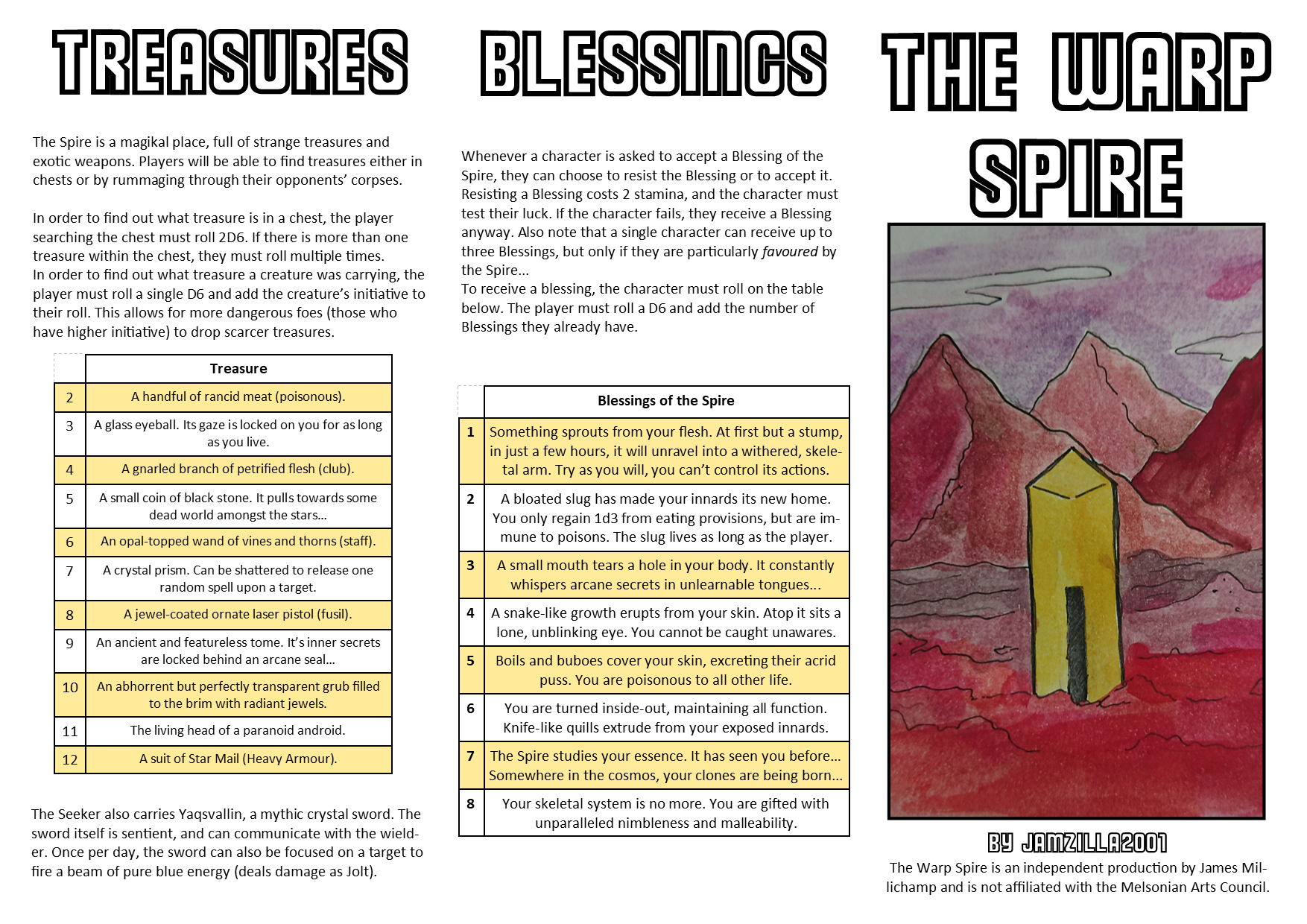


The uncontextualized obelisk-dungeon called The Warp Spire hosts 3 abstracted, unmapped regions teeming with vaguely motivated and unspecific creatures. This smorgasbord of ideas weave an incoherent whole, but with a bit of mapping, context, and elbow grease, this could polish up into a tidy little dungeon.

By James Millichamp


Lich, Laugh, Love



The third pamphlet by Lutra Ludos. Of ten. He certainly knows how to write an NPC (and intrigue, and anything) and this entirely social, city-hall-schmoozing adventure plays well to those strengths. So why do you wound me with your d10 tables, Ludos? You know as well as I that Troika is d6 only. 

By Lutra Ludos


Some Rough Beast


Oh dear. The first by Ludos I dislike. Unlike The Birdcage which makes no overtures towards being immediately usable, Beast is caught halfway between an indulgent evocation and an actual adventure. There's just enough stuff here to tease an assault on an unstoppable, city-demolishing monster that I wish it went all in on practical tools.

By Lutra Ludos


The Calamitous Creation of the Guild of Mechanical Artistry
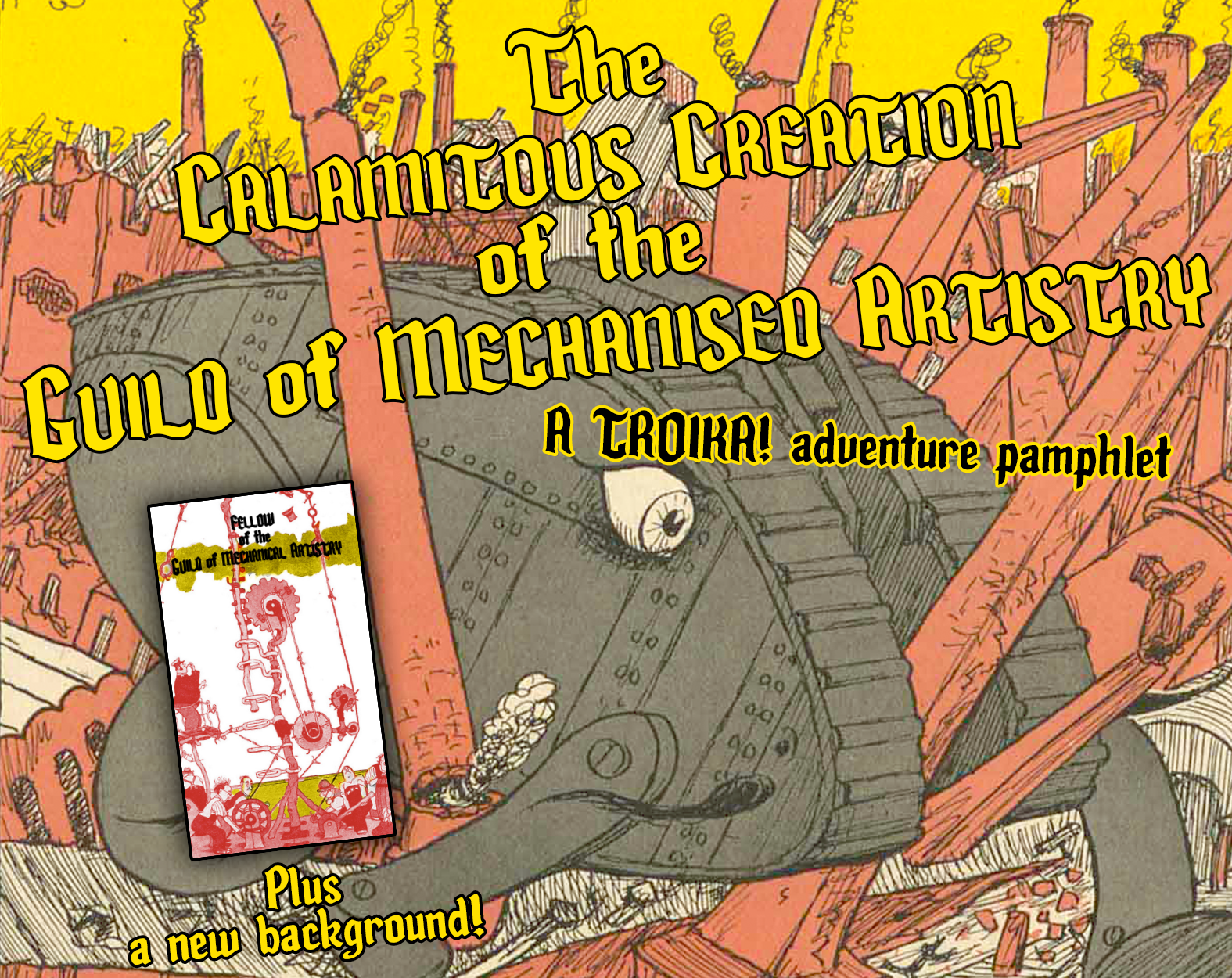


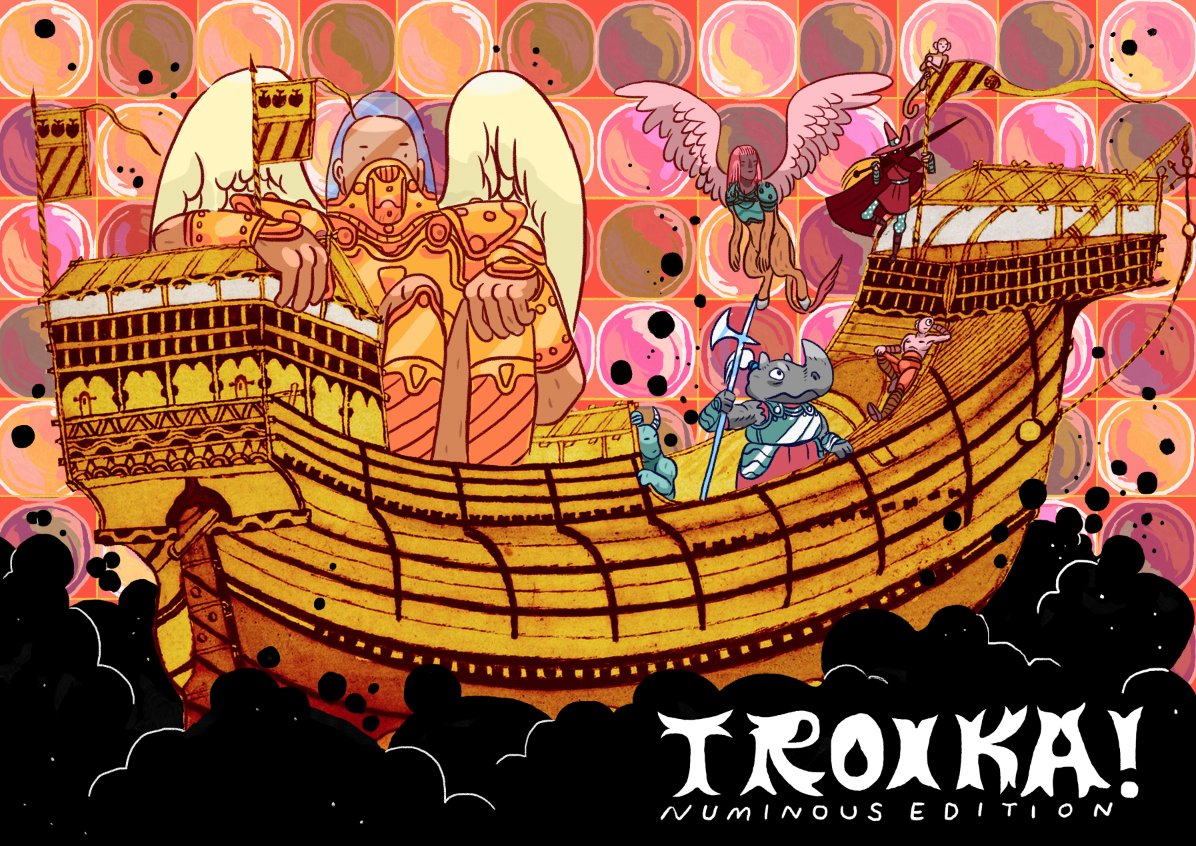
A landship of sorcerous design rampages through the city, and boy am I glad it does. Tables of carnage left in its wake, terrors found inside, and means of halting its advance nourish a savvy GM with precisely the right mix of gumption and fancy.

by Chris Bissette


Why is There a Wizard's Tower in this Dump



I've never been cursed before. At least not that I know of. This pamphlet threatens me, the real human writing this review and potentially (definitely) running the game, with curses too terrible to imagine. I might have to bin my Troika! book, or worse, bring the adventure's terrible wizard into my other games. I love it. It's a negadungeon that never loses sight of the fun. Why is there a blank box on the back page? You'll find out.

by Gordinaak


Finder of the Way



Finder of the Way presents an open ended problem that feels more at home on a hex map than the sole focus of a one-shot. Enraged over a rules dispute while tabletop gaming, an outpost of Dwarves vent their frustrations via gruesome infighting. Without player intervention, the Dwarves will perish and the local town succumb to plague from lack of beer. An intriguing quandary notable for its long term consequences in campaign play.

By Lutra Ludos


Vampire: A Vexatious Tale of Love and Bureaucracy


This miniature definitely-not-Barovia setting overburdens itself with cute bells and whistles, packing light on its best feature: vampiric bureaucracy. Well-crafted pastoral encounters round out the adventure with a breadth of activity, but water down the core bureaucratic theme. If we instead substituted a similarly robust table of encounters inside the tantalizing but underdeveloped "baffling bureaucratic maze", we'd take a great leap towards pamphlet perfection.

By Sealed Library


Welcome to Candy Mountain



The map of Candy Mountain is so good you could almost run a game using nothing else. A supplemental buffet of candy creatures, items, and events pack into dense tables, ready to sprinkle over frosted peaks. While convenient as lists of candy themed things, the ideas written here never quite live up to the fantastical visions conjured by the map and delectably colorful layout.

By Cog 5 Games


7th Annual Conference of Alchemists, Apothecaries, and Accountants
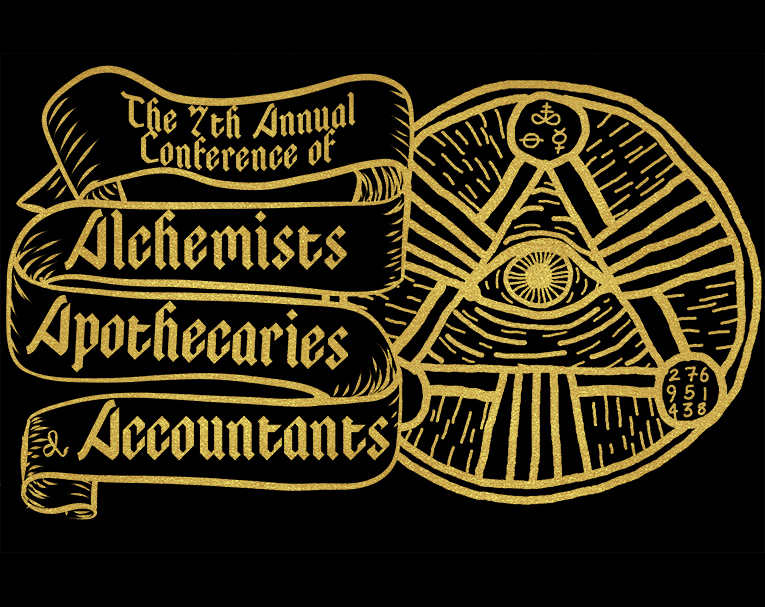


The conference offers things you'd expect from a conference. There's exhibitor booths, scheduled presentations, coupons, a food court. Points awarded for feeling like an in-fiction program brochure, even if it doesn't fully commit to the idea. I want to like this adventure. I adore the idea and the layout made a great first impression, but it far too often goes for gags over practical ideas. It might get a few laughs, but there's just not much to engage with once it runs out of punchlines.

By Aled Lawlor


First Against the Wall



A revolution in progress so on the nose, inclusion of dwarves and elves and magic feels silly. And not in a good way. It vacillates between comic absurdism and harsh political reality in a way that makes me want to drop all pretense and just play a modern day insurgency style game. If you want it, there's plenty of adventure here between the encounters and complications and NPCs and jargon.

By Lutra Ludos


Armistice Unknown: Prelude to Conflict


This PvP scenario cleverly uses 3 pages to provide each team their own pamphlet with an introduction and secret, faction-specific information. The pamphlets predominantly cover set dressing, leaving specifics to player machinations. One team protects their high priest from assassins--the other team. I have a personal aversion to PvP in RPGs from a number of bad experiences, but this seems like a solid scenario should you find a competitive group up for the task.

By Maria Rivera


Let's Kill God



Like some others by Lutra Ludos, this is a prompt more than an adventure. Other than a spectacular table for generating god names, the contents circuitously restate the title. Do your players want to kill god? This pamphlet might convince them, but you'll be left holding the god-shaped bag.

By Lutra Ludos
Sunday, June 21, 2020

Troika Pamphlet Jam Reviews, Part 2

I posted my first batch of reviews for Melsonia's now-completed pamphlet adventure jam nearly a month ago, with the plan to release around 6 reviews a week until I finished the lot. When I got started, there were a manageable 20 or so pamphlets posted to the jam. It concluded with a much more daunting 52. I still plan to review every single pamphlet from the jam, but I'll likely be cutting the length of my reviews down to a couple sentences each and releasing reviews in larger batches. Here I'm posting the 9 paragraph-length reviews I finished before life got in the way a couple weeks ago.

In early June, I popped my head into a brand new discord server created to organize the creation of an adventure anthology to benefit BLM bail funds. I soon found myself neck deep in the project, juggling efforts to coordinate almost 100 volunteers and write a 2-page Mothership adventure of my own. 10 days after we started, we had a complete, 140 page book called Dissident Whispers containing almost 60 adventures for a wide variety of RPG systems. We raised over $25,000 for the National Bail Fund Network in 24 hours after its release. I've never been more proud of anything I've done in my life, and I heartily encourage you to check out the project if you haven't already. There's even a couple (very good) adventures for Troika! in there.

Learn more about Dissident Whispers and find links to pick up a copy at our website:
https://whispercollective.org/

Links to the rest of the reviews:
Part 1
Part 3
Part 4
Part 5

And now, the Troika pamphlet reviews:

Flea Market


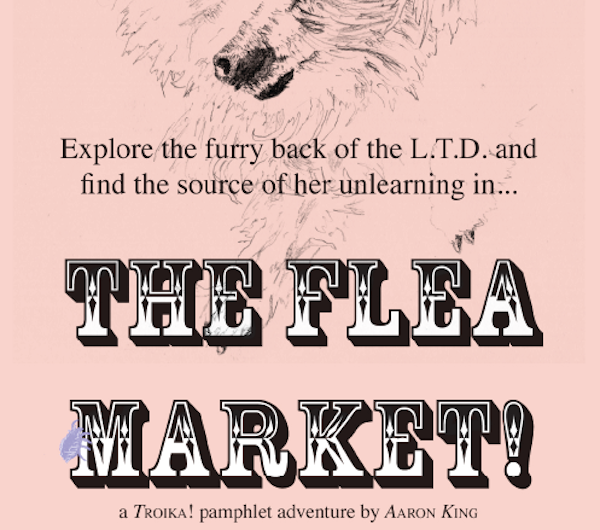
The Learned Troikish Dog, teller of truths, shrinks the party to sub-flea scale to quest for stolen, bloodborne knowledge in The Flea Market by Aaron King. Adventure awaits within the organs of a flea enslaved by vampire gnats. Compete with a gallery of tiny NPCs for answers to life's questions on auction as scabby artifacts--brilliantly creative treasure. The open and evocative setup fills the mind with countless schemes and alternative goals. Further reason to run Flea Market is the potential for more adventures in the shrinkoverse and with the Learned Troikish Dog. No campaign plot is likely to survive an encounter with this charming scenario. In the author's words: "This is your game now. The flea is like a golden barge."


Blockaded in Bahlgran


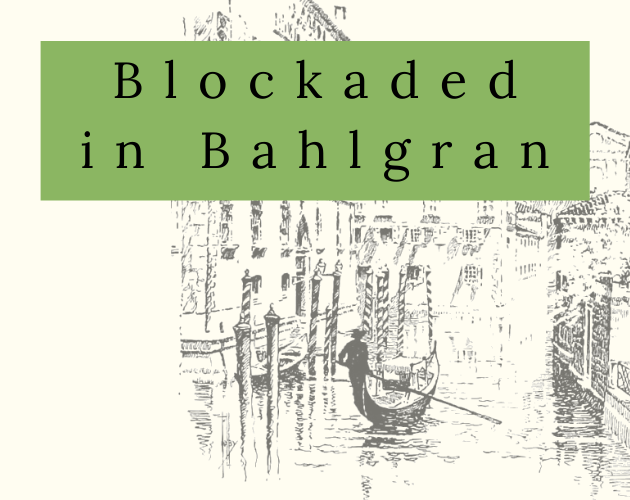
Blockaded in Bahlgran by Rollin Salsbery conjures a rich and palpable vision of a besieged fantasy-Venice. Mimes wield invisible swords, islands bristle with intrigue and flavor. However, like the gondolas that ply its canals, this "adventure" feels rudderless. More a setting than an adventure, Blockaded offers no context to orient the players or kick things off. Juicy hooks dangle from every shore, but in the tiny space allotted by a pamphlet they feel too undeveloped to explore without some heavy lifting. Make no mistake, I love what's here and will absolutely keep this waiting in the wings during my next Troika campaign, but I feel this brilliant setting demands more space than the pamphlet medium allows.


Scions of Sessar


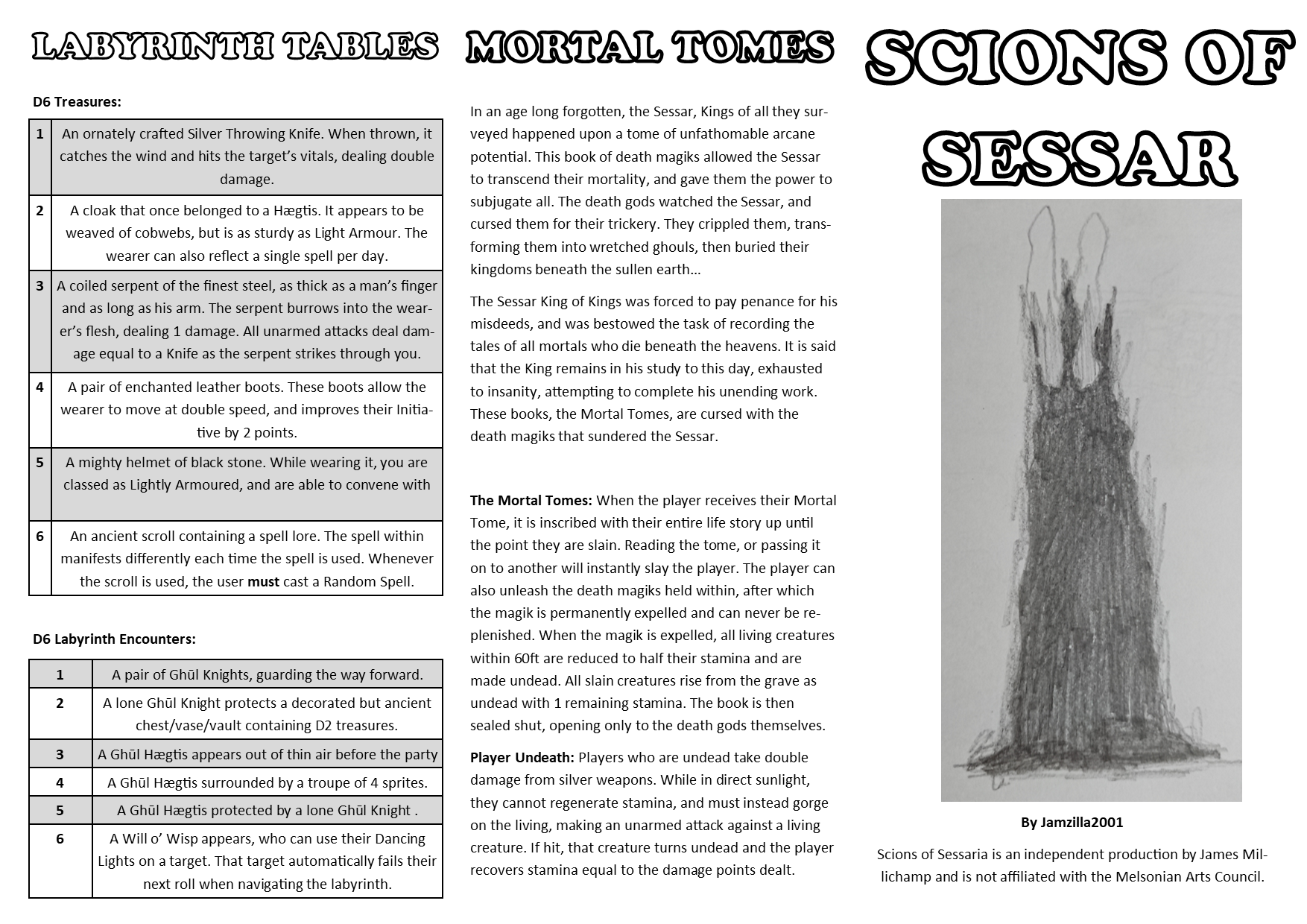
Scions of Sessar by James Millichamp leads with a lore dump and marches through gloomy dungeon points of interest. The scenario maintains a death grip on the prescribed path forward until the very end, leaving little room for player creativity. Still, it isn't unsalvageable. It needs some breathing room. It needs goals. Some motivation for the random-encounter NPCs here, a little less encouraged player backstabbing there, we're starting to get something cooking. What if the players started the scenario dead, and this trek through the misty underworld ended with a rewriting of each character's death-book to bring them back to life? Now that's an adventure I could share a beer with.


Beneath Damp Sands


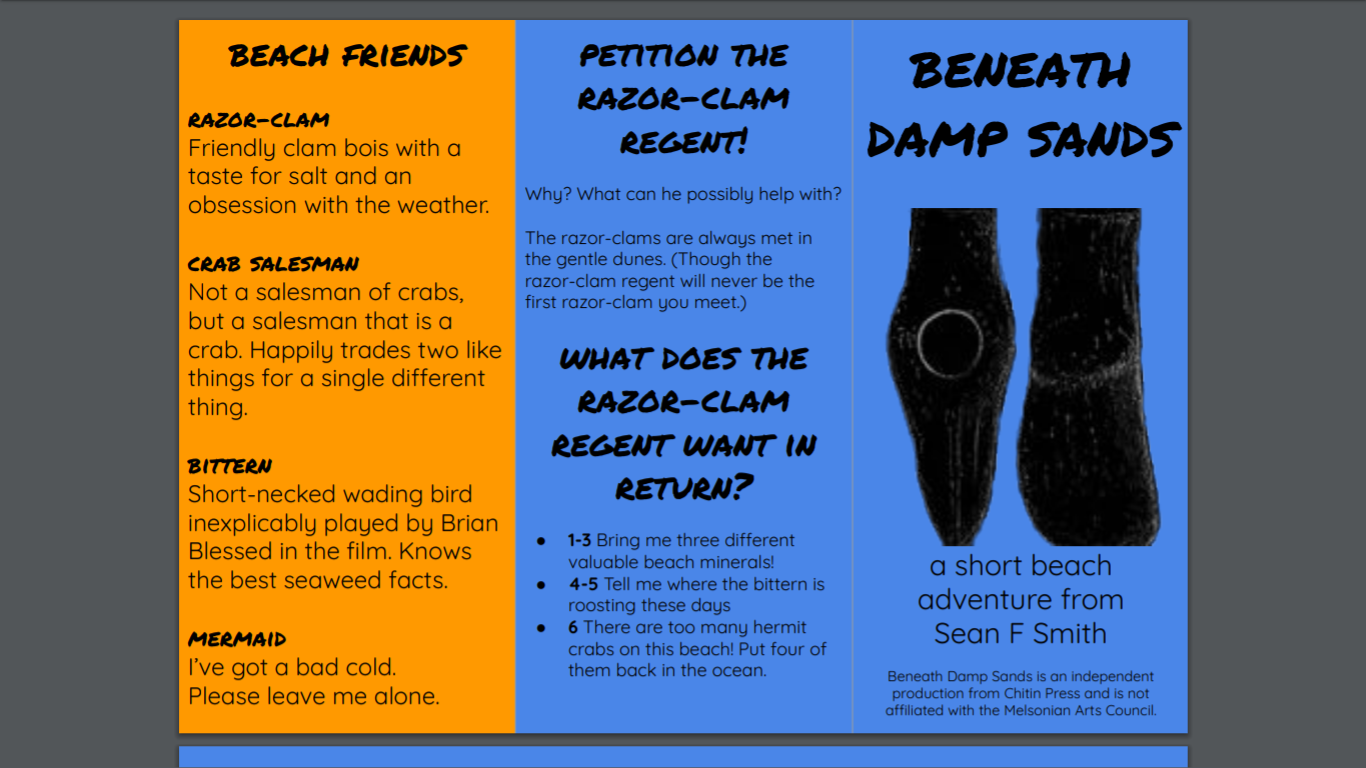
In his third submitted adventure, Sean F. Smith teases with an underdeveloped but lovely adventure concept. Comb the beach for the Razor-Clam Regent and undertake cute, peaceful little quests for his favor. A brilliant concept marred by dismissive, saccharine twitter-speak and painfully sparse design. I yearn for a version of this taken more seriously, but I still plan to keep this in my back pocket for a campaign that needs a shot of childlike joy.


The Birdcage


I dislike backstory. I particularly dislike backstory choking out space for gameable material from the narrow confines of a pamphlet. The Birdcage by Lutra Ludos fills its 2 pages almost entirely with long paragraphs of backstory and lore, and I find I like it despite myself. Holy relics from an ancient crusade await brave adventurers in the titan-bone sky prison, the Birdcage.  Only 1 of the pamphlet's 6 columns provides material to assist a GM in running an adventure within the prison: 3 evocative tables of prison residents and dubious jobs. As these tables conjure fantastical images of adventure, the giant blocks of text on the next page taunt and provoke me. The Birdcage dares the reader to fill in the massive gaps left by its backstory and run a campaign worthy of its grandeur. I'm unsure if it's worth the effort to develop this in the face of so many immediately runnable scenarios offered by this jam, but it's tempting.


A Wizard Did It


The second of five pamphlets submitted by Lutra Ludos (at the time of this writing) continues a tradition of quality that I suspect will hold for the rest of his entries. Three feuding wizards teleport the PCs to a demiplane to mediate their intense but obscure argument. With this brilliantly simple concept, the author leaves plenty of space to luxuriate in fun tables: a graphically fascinating relationship wheel, dark secrets between the wizards, and my favorite: dramatic twists befitting a stereotypical "DUN DUN DUNNNN" sound effect. Descriptions of the wizards equip theatrically-inclined GMs with all the material they'd need to perform, but as a poor actor I fear I'd fail to do justice to these complex character snapshots. This pamphlet would sing in the hands of a certain kind of GM, but I'm confident even the clumsiest roleplayers would have an uproariously good time probing the wizards' absurd facades.


In The Thicket


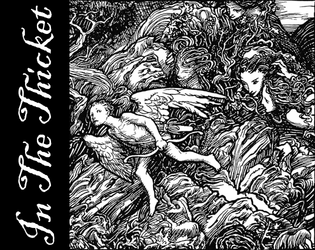
Jonathan Dersch pens another pamphlet replete with public domain art and practical ideas. Six dryads preside over a botanical katamari-sphere. Die drop mechanics establish each dryad's domain and encounters within while sylvan adventure hooks push players in all the right directions. A fury system tracks crimes committed by PCs against plants and dryad-vibes, raising the encounter table die rolls towards more dangerous events. However, the structure of said table and recommended die drop dice size mean players are unlikely to encounter hazards that would begin them down the path of plant slaughter, keeping their fury low and beginning a vicious cycle of peace. Encountering chaotic blight (alluded to by the introduction and represented only in the highest reaches of the encounter table) or dangerous creatures seem a far less likely result of incurring the thicket's wrath than meeting gentle wild animals (entry #5) instead of a tranquil clearing (#2). Despite my complaints, some minor retooling to the clunky fury system could easily spruce up this otherwise solid adventure.


Something About The Gnomes


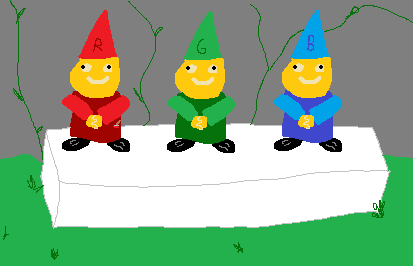
Garden gnomes loose in the botanical gardens and free sandwiches await in Something About the Gnomes by PanicMolt. Endearingly DIY layout efforts jump off the page: MS Paint art, stats via spreadsheet screenshots, haphazard paragraph placement. Hit-or-miss encounters in the garden's 6 rooms lead to the hiding spots of 3 rogue gnomes. The good: A plant-overprotective, job-insecure rhino man, a den of cannibalistic tigers. The less good: A quiz with joke answers tied to skills, a large frog, passive voice. Should all gnomes be returned for relocation to new pastures, the players earn free sandwiches for life. Who doesn't want free sandwiches for life?


SENTIENT ARMS OF THE WORLD, UNITE!


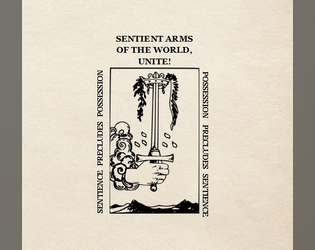
Delectably absurdist revolutionary factionalism abounds in Sentient Arms of the World, Unite! by Ben Foster. Hopeful propaganda introduces the Revolutionary Commune of Sentient Arms and its righteous tenets of pro-sentient arms liberation and anti-adventurer abuses. The RCSA squats on a dilapidated and teetering 19-floor high tower, rooms sagging with hazardous co-tenants and ambitious sub-committees. Despite a wealth of tables and information for NPC and factional goals, the sheer scale of the tower leaves wide gaps in gameable material. Without encounters, there's little sense of the tower as a complete ecosystem rather than isolated and static rooms. Vaguely antagonistic interior politics and a resounding lack of actual counter-revolutionary scheming means players have little concrete intrigue to grab onto. Sentient Arms feels like a prelude to something greater: The hub of an anti-adventurer revolutionary campaign rather than an adventure in its own right. I'm left pining for the brilliant political intrigue scenario that could have been, but still relish the pamphlet's revolutionary aesthetics and sincere charm.

Monday, May 25, 2020

Troika Pamphlet Jam Reviews, Part 1


The Melsonian Arts Council is currently running a pamphlet adventure jam for Troika! over on Itch.io. Here's a link: https://itch.io/jam/troika-pamphlet-adventure-jam I absolutely adore Troika and pamphlet adventures so thought I'd take a stab at reviewing every submission to the jam. I'm going to be posting short reviews in batches of 6, in submission order (from oldest to newest). After the conclusion of the jam and I've finished all my reviews, I'll post some summary thoughts and assign arbitrary awards to my favorites. I'll try to have fun with this, and I hope you do too.

You may ask, who is this man and what authority does he have to judge these works? I have fair familiarity with Troika, having both played and run dozens of sessions. You can read some of my Troika writings on this very blog. I wrote three (and am in the process of writing more) pamphlet adventures for Mothership, one of which is so far published. I am a pamphlet fan.

Game jam entries are made under time constraints and many of these pamphlets were released for free. My intention with these reviews is to provide fair and honest criticism and feedback for the works on their own merit, not evaluate them as commercial products. I will try to be as constructive as possible.

Here's some links to the other batches of reviews, updated as I post them:
Part 2
Part 3
Part 4
Part 5

Carnelian Riddle in the House of Indolent Blooms


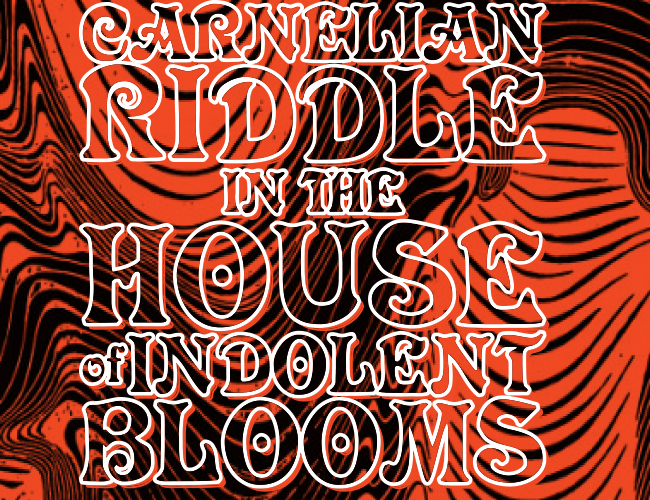
What is there to be said about Micah Anderson's Carnelian Riddle in the House of Indolent Blooms? It's good. It's very good. It's beautiful to behold. It drips with dazzlingly imaginative ideas. It's more than worthy of the Troika compatibility Fortle. Players stumble through the fantastical and logic-twisting grounds and halls of the Carnelian Sphinx's Grand Observatory in desperate search of social faux-pas lest they be trapped there for 100 years. The author jam-packed this pamphlet to the point of bursting. It easily hosts enough material to run a short campaign, but the tiny text verges on the point of impracticality for the format. To praise all that's praiseworthy here demands far more space than these short reviews allow. There are riddles. Good ones. The NPCs delight. The rooms fill me with wonder. I almost wish I hadn't read it because I want to play it, badly. I'd buy a fancy printed version if one were made. You should too.


Suburban Cathedral


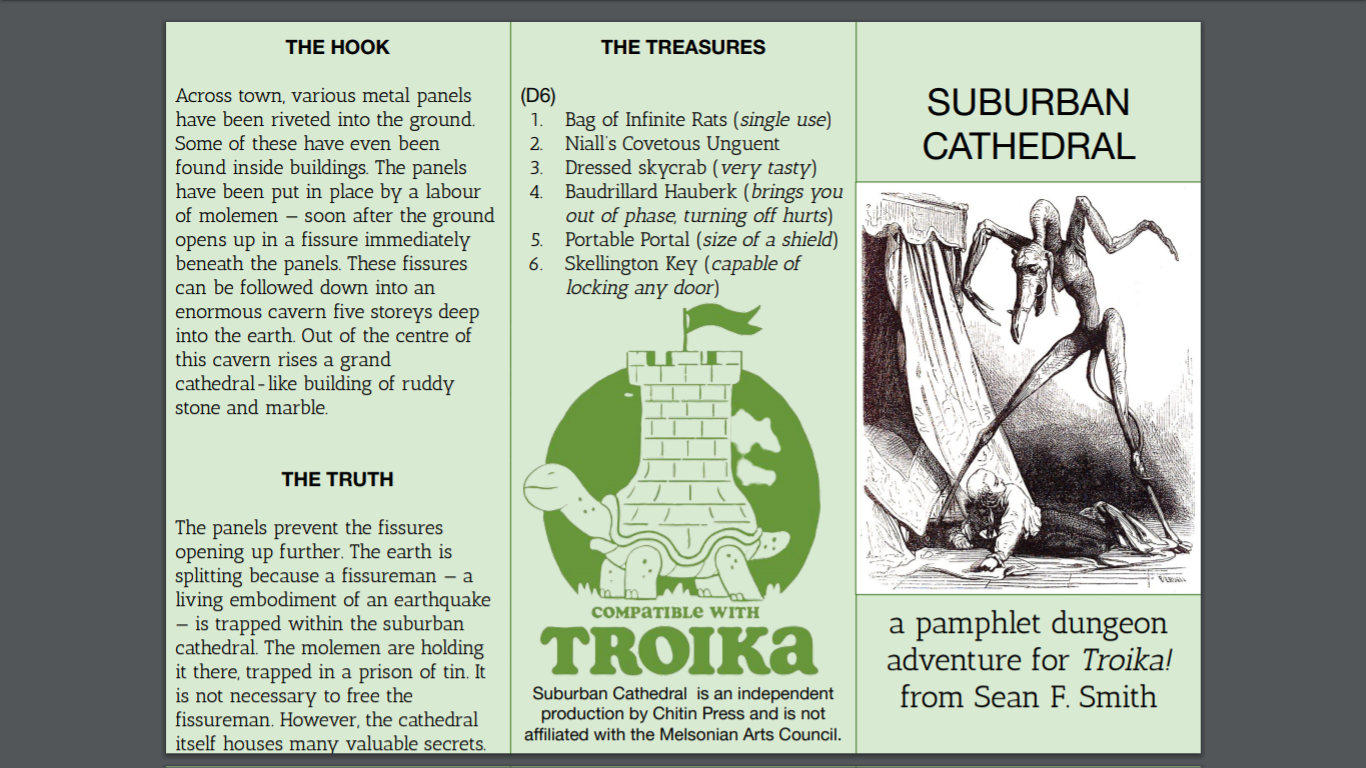
Suburban Cathedral by Sean F. Smith plunges adventurers into a subterranean mystery. Molemen imprison an earthquake generating creature in a monster infested cathedral beneath a fissure-ravaged town. For what purpose, the pamphlet doesn't say. Six intriguing creatures compose the meat of this scenario. I appreciated that the author provided a truncated (2 options) Mien selection for each rather than scrapping the mechanic entirely. Alas, there's little more here than the creatures and a d6 table of mostly setting-disconnected treasures. The pamphlet loses precious space to verbose, passive language, an unnecessarily large Troika compatibility logo, and a section of unhelpful notes on map-making. I'd have liked to see a public domain floor plan instead. The encounters procedure relies too heavily on monsters and misses opportunities to reinforce the earthquake-plagued subterranean setting: no cave-ins, no quakes. The mystery at the heart of Suburban Cathedral gets my imagination going, but the incomplete-feeling content of the scenario leaves me unsatisfied.


13 Story Bazaar


13 Story Bazaar by Jonathan Dersch tasks players with retrieving a magical flying vase from a rooftop antique store for their grandmother. 24 encounters laden with tomfoolery and danger complicate the climb through 13 floors of shops. A handful of encounters engage multiple floors or the tower as a whole: feuds between establishments, vehicles to traverse multiple floors. Most add threats or texture to a single floor. This scenario was originally written in 2019 for OSR systems and it shows. Bazaar lacks the color of a Troika adventure and too-often prefers the generic to the specific. Classifications of generic establishments, generic fantasy NPCs, and often-vanilla-feeling encounters cast a grey pall over the otherwise fun and dynamic premise. The scenario includes a separate pdf with Troika-compatible NPC stats and a single (charming) background that breathe some Troikian whimsey into the pamphlet, but not quite enough to sufficiently alter the tone.


Undeath of the Author


Undeath of the Author by Quinn B. Rodriguez is, as the author states, insufferably meta. I have little experience with and love for lyric games (of which I believe this is one), and therefore do not feel qualified to review this pamphlet on its own merits. As a Troika adventure, it is not.


The Milk Provider


The Milk Provider by Gustavo Tertoleone gleefully assaults the reader with neon colors and pop culture references. The rear blurb asks if I'm brave enough to enter the crazy unicorn's lair. I'm genuinely unsure. Said lair brims with madness: sentient LSD, a K-Pop band, candy people bursting from jelly pools.  The writing is verbose and often confusing but who cares, we're here to do acid and have fun. This is the perfect scenario to toss a bunch of your rowdy drunk friends into and together drown in its chaos.


Vast Marsh of the Snail-Holm


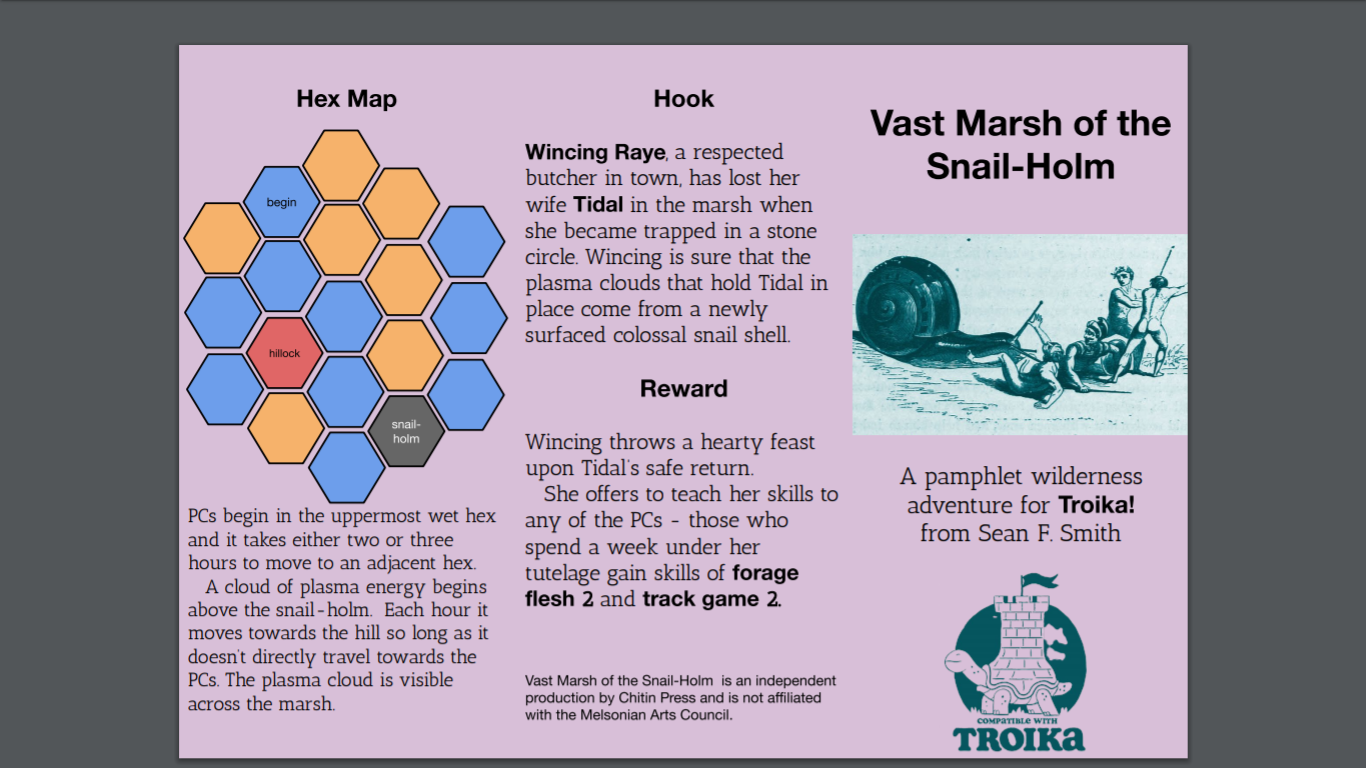
Vast Marsh of the Snail-Holm, another by Sean F. Smith, casts players into a plasma-storm-swept marsh in search of a magically imprisoned butcher's wife. This short hex crawl threatens players with natural beasts and pests. Giant frogs are as weird as things come out in the brackish pools and reed beds. The adventure relies on the path of the abovementioned plasma storm to sweep players from the most direct route and send them fleeing deep into the marsh, but the confusing language governing its movement and total lack of indication of its effects fails the GM. The adventure concludes with a solid 3-room dungeon inside a giant snail shell, though I wish I knew more about the being generating the storm than its stats. Should the players succeed in freeing the butcher's wife, she rewards the players with an opportunity to learn butchery skills--which I like. There's a nifty scenario here, but it's buried beneath a poorly explained central conceit and dull hex crawling encounters.

Monday, May 18, 2020

Anatomy of a TPK

I've been running a weekly Mothership campaign for a few months now. I string together a series of short scenarios (written by myself and others) in a loose campaign framework. PC mortality rate is high: averaging around 1 death/session. In our last session, my players TPK'd in spectacular fashion chasing down a bounty to her penthouse hideout.

The Scenario

"BLACK EYES" wanted for piracy of corporate assets. Bounty is armed and dangerous.

The Job

Assets:
One (1) Azure Horizons Cryosuit™
  • Experimental, ambulating cryopod. Performs all functions of a hyperspace-maintenance android without the wasted space of a bulky, traditional cryopod.
  • Retrieval: 30kcr (pristine), 10kcr (functional)
One (1) Senior Azure Horizons Accounting Officer "Hector Rios"
  • Presumed still asleep inside the Cryosuit™. Corporate credit card recently used to purchase 2 months stay in Plaza Nouveau's penthouse suit, plus room service.
  • Retrieval: 5kcr (alive)
Hostiles:
"Black Eyes" (aliases unknown)
  • Dead or alive: 10kcr
Unknown # collaborators
  • Dead or alive: 1kcr each

The Situation


  • High-rises surround the Plaza Nouveau hotel. Balconies separated by 20m.
    • Front door booby-trapped with a shotgun. Fires through the door if latch fully extended.
    • All shades drawn, windows locked.
  • Cryosuit hacked, protects Black Eyes and her crew.
    • Combat: 50   Instinct: 10   Hits: 3 (80)
    • Grapples hostiles, snaps limbs.
    • Rios visibly wounded if suit takes damage. Killed if suit takes 1 Hit.
    • Moves to provide Black Eyes cover, engages hostiles who approach in melee range.
  • Black Eyes & crew prepared for lethal engagement.
    • Combat: 40   Instinct: 30   Hits: 2 (20)
    • Black Eyes (SMG, grenades) on watch in the living room. 
    • Redd (revolver) using the south-east bathroom. Enters combat after 1 round. 
    • Klaus (shotgun) asleep in the north-east bedroom. Enters combat 1d5 rounds after Redd (if comrades killed first, ambushes PCs who enter his bedroom).
    • Willing to negotiate release of the suit and Rios: 100kcr wire transfer (company will not agree).

How it Went

My players were in deep shit with Azure Horizon's parent organization after murdering several of their employees to cover up the events of previous missions. In response, the company strong-armed the party into indentured servitude. They burned the party's contacts so the only available jobs were corporate issued. They slashed the pay of remaining jobs and squeezed the party with higher prices for company-owned goods and services. The party was already poor and deeply in debt (to the company) after purchasing a [haunted] ship. Mercenary salaries and docking, lodging, and fuel costs burned through what was left of their savings. They were desperate for a payday and took what they could get: this bounty job. After the price cuts, it paid only 10kcr.

On route to the hotel, the pilot attempted to save some fuel by cutting thruster use to a bare minimum on approach to the city's docks. He ended up crashing into a company-owned sensor array and racked up additional debt worth 7x the job's pay.

The party forwent any attempts to recon the penthouse. They planned to zipline down to the penthouse from an adjacent building and eschewed a potentially time intensive or pricey search for climbing harnesses in favor of a (critically failed) jury rigged solution.

They climbed a convenient fire escape and handed the rigging gun off to their NPC mercenary. 2 misses. The first shot hit low and needed reeling in. The second went through a penthouse window. Hastening to capitalize upon what element of surprise remained, the party ziplined down in the following order:

1. Potts, Teamster
2. Rabbitt, Marine (NPC mercenary)
3. Charlie, Marine
4. Brody, Teamster
5. Carver, Scientist

As a consequence of the critically failed jury rig roll, I randomly rolled for one of the crew's harnesses to fail mid-zip. Brody. As he fell, he quickly whipped his cowboy hat off his head and over the line in an attempt to save himself. Speed test at disadvantage or die: Success. He dropped his weapon in the process and rode his hat the rest of the way down.

The zipline inconveniently terminated in the middle of the penthouse's living room floor, meaning a painful slide through broken glass as characters struggled to free themselves from the poorly wrought harnesses.

The situation was bad.

Potts came in hot off the zipline and freed herself with the expertise only the creator of those terrible harnesses could possess. In the kitchen on the far side of the room, Black Eyes was ready for her. She stood behind the Cryosuit for cover, using its shoulder as a firing position. Potts fired her shotgun at Black Eyes and missed, instantly killing Rios inside the Cryosuit. Black Eyes returned fire, screaming "DIE MOTHERFUCKER", and shredding Potts's left arm (critical hit: bleeding out).

Potts ran for cover as Rabbitt shredded his back on the broken glass during entry. As Rabbitt got up and made his way to flank around the right side of the Cryosuit, one of the kidnappers (Redd) came out of the bathroom and shot him in the back of the head. 1 down.

Meanwhile, Potts gave up on shooting and rushed Black Eyes to club her with the back end of the shotgun. She missed: the Cryosuit's arm reached up and grabbed hers in a vice-like grip. Potts took some point-blank SMG fire and after failing to flip the shotgun up in the air and catch it by the grip, the Cryosuit broke her arm and she passed out. 2 down.

During Potts' ill-fated charge, Charlie touched down on the deck and engaged Redd with his SMG, who went for cover in the south-west bedroom. Brody arrived in the middle of the arm-breaking and sprinted across the room to tackle Black Eyes. He successfully pinned her against the heated stove top and they began a prolonged struggle for dominance. Carver critically failed their entry and knocked themselves out against the living room furniture. 3 down.

Aside: I majorly fucked up with Carver. It took way too long for them to get into combat (I should have sent in 2 PCs/turn instead of 1), and when they did arrive they immediately got knocked out and subsequently killed. I'm very anti-roll-fudging in general, but in this case I'd already kept them sidelined for way too long and should have picked a different critical hit result or skipped that roll entirely. Sorry Ryan!


Redd moved to flank Charlie by climbing out the bedroom window and crossing the southern "Green Roof" to get to the deck. She sprayed Charlie's position behind the couch with bullets but failed to do more than alert him to her presence. Charlie decided to break out the grenades and lobbed one out on the deck, obliterating Redd but also catching Carver in the blast radius. Even taking only half damage because of cover, Carver died in the blast (again, sorry Ryan!)

The final kidnapper, Klaus, roused himself from a mid-day nap and cocked his shotgun as he stepped into the living room. Brody concluded his struggle with Black Eyes by bashing her head in with a cast iron pan, then turned to catch a face-full of lead from Klaus's shotgun. 4 down. Charlie tossed another grenade in Klaus's direction but the Cryosuit snatched it out of the air and smothered the blast, destroying itself and decidedly murdering the barely-alive Potts.

Klaus walked through the wreckage and kicked over the sofa which Charlie had pulled over for cover, pumping his chest full of lead. Barely clinging to life, Charlie tossed one last grenade at Klaus's feet as he turned to search for survivors. With that, there were none.

Thoughts

Aside from my guilt about how I mishandled things with Carver, I had a lot of fun with this session. It felt exactly like the kind of massacre that results from shooting your way into a hostage situation without any intel. After facing and mostly surviving paranormal terror after paranormal terror, a few common criminals finally TPK'd this resilient party. After the session, I asked my players for feedback. Some players had a good time with the chaos. They may have died, but at least they took all those bastards with them. Carver's player politely expressed displeasure at being sidelined for the entire game, very understandably. Someone mentioned that it felt like a Tarantino film, which is precisely what I was going for.

Despite using no explicit horror tropes, this scenario dripped with tension. My players got in over their heads very quickly and they knew it. I was concerned that a mundane bounty mission might not hold water compared to supernatural scenarios, but it felt equally intense, terrifying, and Mothership.

My players and I decided to keep the campaign going with a new party. They expressed interest in taking over as the next owners of their spooky ship, which gives us a lot of leeway about who that party might be and under what circumstances they acquired the ship. I'm looking forward it.

Monday, May 4, 2020

Stumbling Through RPG Self-Publishing

In the past few months, I've stumbled my way through the process of developing and releasing a small, 2-page RPG scenario for the Mothership RPG. Though many other creators have come before me, it's been an exciting process and I thought others might be interested to hear some bits and pieces I've learned along the way.

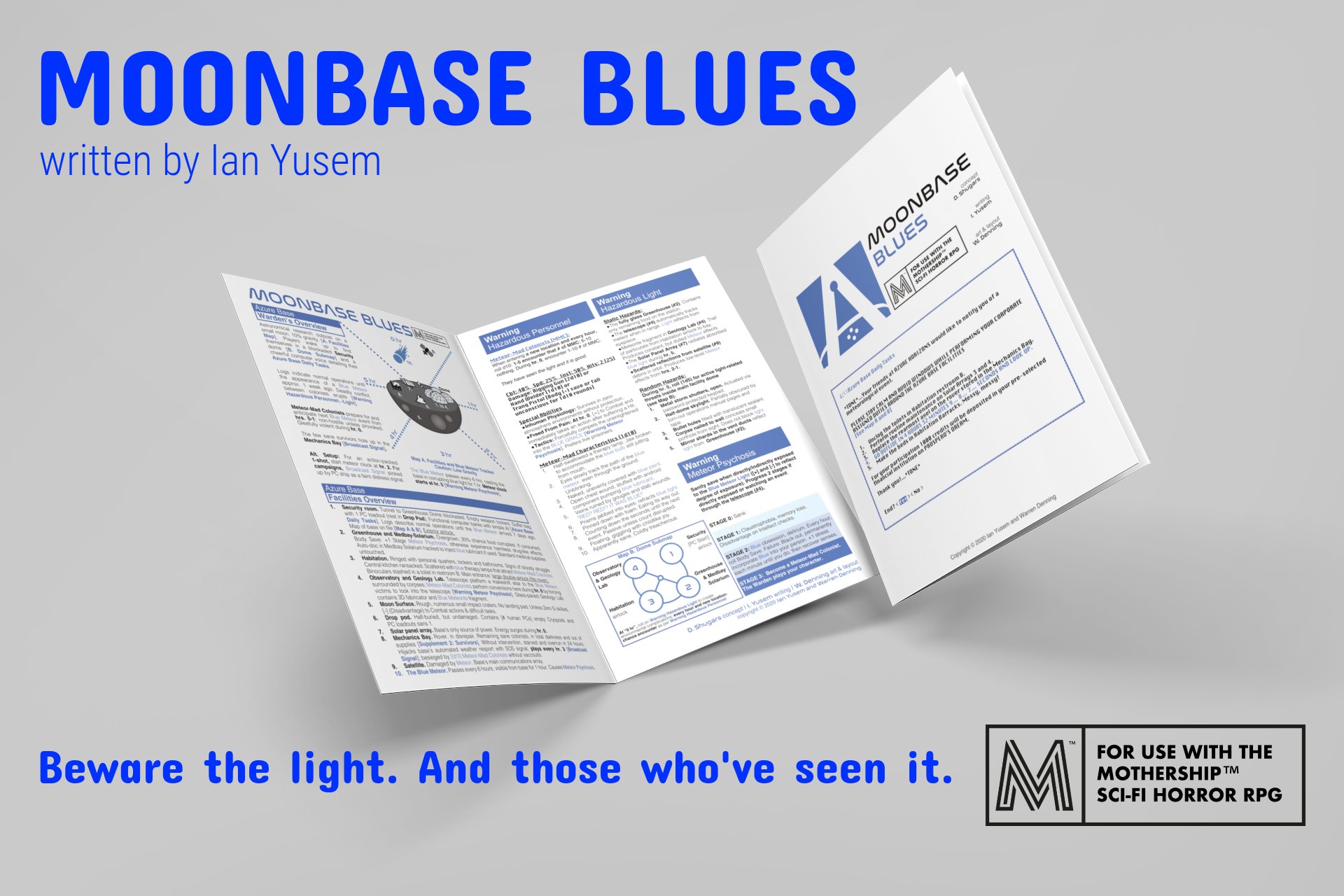
Back in January, Dai Shugars posted a fun prompt for a Mothership scenario in a discord server I use. I elaborated on the prompt with a d10 table to use with the scenario, and left it at that. After some encouraging words about the table, I decided to flesh it out into a fully playable scenario. A month or so later and with Shugars' permission, I had a blog post I was pretty happy with. I posted it to the always-bustling Mothership discord server as well as r/rpg, where it was met with modest interest. As of right now that blog post, "Moonbase Blues", sits at about 600 views.

A few weeks went by, I continued to write blog posts and I started running the scenario for my regular Mothership playgroup. Out of the blue, I got a message from someone I'd seen hanging around the Mothership discord but had never spoken with, Warren Denning. Turns out he'd read Moonbase Blues and liked it so much that he laid out the scenario onto a professional-looking 1-page spread with maps to use in his home game. I was floored by the work and the compliment it represented. It made me feel like the blogging I'd been doing, which had heretofore received minor engagement, was all worth it.

Warren and I got to talking about what to do with the pdf. We both agreed that we should release it to the community, but weren't sure if we should try and sell it or put it out for free. We got in contact with Sean McCoy, the creator of Mothership, who began supplying us with a TON of excellent advice and support. I seriously cannot thank him enough for the help he's given us on this project. He encouraged us to sell the scenario for a similar price point to The Haunting of Ypsilon 14, an official 2-page one-shot scenario released for Mothership earlier this year. Because the free version of the scenario exists on my blog for anyone wanting to play it but without the inclination or financial ability to pay, Warren and I made the final decision to try and sell Moonbase.

With our decision to sell the product, we started working to polish up the material and expand the scope to fill both the front and back of a double-sided pamphlet. We added more content, tweaked and improved the layout, and made several editing passes. Meanwhile, we began to work on the logistical and marketing side of our project.


First, we had to decide where to put Moonbase Blues up for sale. DriveThruRPG is the largest online RPG marketplace, and other Mothership products have had a lot of success there. There's also Itch.io, a marketplace primarily used for video games sales but with a burgeoning RPG scene. DriveThruRPG takes a 30% cut of pdf sales for products sold exclusively on their website, and a 35% cut for non-exclusive products. Furthermore, they require an 18-month wait time to switch a publisher account from exclusive to non-exclusive. Itch.io takes 0%, with an option to donate a percentage of the creator's choice to maintain the site. DriveThruRPG also awards products with medals according to sales numbers and visibly promotes high-selling titles, pushing creators towards putting all eggs in their basket.

I reached out to Sean McCoy for advice, who shared that Mothership received roughly 80% of its sales on DriveThru and 20% on Itch. Doing some table napkin math, I applied those numbers and determined that one would keep 72% of a product's profits selling on both DriveThru and Itch, compared to 70% from going DriveThru-exclusive (assuming equal sales numbers). I also got in contact with Aaron Sturgill, the author of Vita Nova, a 3rd-party Mothership scenario that had been for sale on DriveThruRPG for several months. Aaron also graciously shared some of his sales experiences, and told me that Vita Nova had enjoyed very consistent sales on DriveThru since its release. With this information in hand, Warren and I weighed our options and came down on the side of a simultaneous Itch and DriveThru release. Though it seemed DriveThru was helping to promote its games and drive consistent sales, the numbers were close enough that we decided to err on the side of being less constrained in our future options.

Next, we tackled the hurdle of copyright. We wanted to protect our creation but avoid the relatively costly copyright registration fee (around $50, depending) on this very small project. Luckily, an attorney friend of mine shed some light on copyright law for us. From her advice and my own research, I learned that published works in the US automatically gain copyright protections upon creation, no registration required. Even a notice of copyright is optional, though we decided to post one on the pdf for thoroughness.

Now fully prepared with our completed files and all decisions made, we went to release our little scenario. I created pages on both DriveThruRPG and Itch.io and went to hit the button to upload my files to the latter site when DriveThru notified me of an approval process that would take up to 5 days. I wasn't aware of this requirement, so had to postpone release plans.

On the following Monday, I got an email from DriveThru that Moonbase was not only approved, but automatically pushed live to their marketplace. If I'd wanted the option to choose when it went live, apparently I should have set a specific release day in the future. I scrambled to organize some marketing posts before I lost the benefit of DriveThru's algorithms for newly posted content. I posted links to both the DriveThru and Itch pages to the Mothership discord, my twitter account (which had only 15 or so followers), and to a few subreddits in the body of a longer text post explaining the story of its creation and linking play reports from Warren and I.


Sean McCoy and several other notable RPG people retweeted me, so my post managed to reach a decent number of people there. On the discord, Sean posted Moonbase to their "announcements" channel where it was much more visible. My posts to reddit did better than expected, receiving some attention on both r/mothershiprpg and r/osr but climbing almost to the top of r/rpg. The marketing effort felt like a reasonable success despite my minimal social media presence, largely due to help from others.

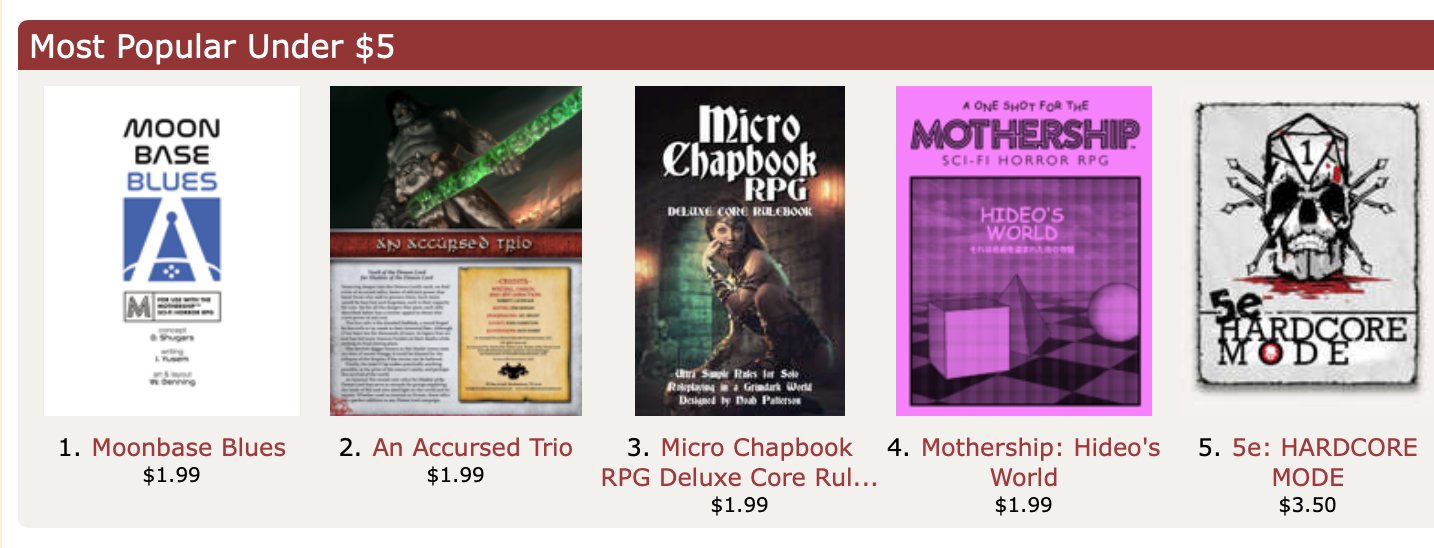
Within a few hours of my posts, Moonbase shot to the #1 spot on DriveThruRPG's "Most Popular Under $5" section, which is prominently visible on the site's front page. It stayed there at #1 for an entire week, and has only today dropped to position 3. I attribute many of my sales on DriveThru to this. On the first day of release, Itch accounted for approximately 1/4 of our sales, but that ratio soon trailed off as Itch sales dropped to almost nothing. DriveThru sales remained fairly consistent, tailing off but at a slower rate. We earned a Bronze Best Seller badge from DriveThru within the first 24 hours of our release and Silver a couple days later.


Itch sales have settled at around 15% of our total sales, not far off the 80/20 estimation shared by Sean. I feel good about our decision to go non-exclusive, mostly because it's given us flexibility while seemingly doing no harm to (or even slightly benefiting) our sales numbers. I think in the future, I might choose to only promote a DriveThru page for a new product now that I know the vital importance of hitting its front page (which would be impossible on Itch given competition with the much more popular video games on the site), even if I was posting to both DriveThru and Itch.

Despite our rookie mistakes and various unforeseen problems and challenges, this all worked out pretty well. Starting on a small, manageable project provided plenty of trial and error learning opportunities without setting the stakes and stress too highly. Warren and I haven't earned back anything close to minimum wage given the many hours we spent on the project, but we have a shiny silver medal and a lot more experience under our belts than we started with. Perhaps most importantly, I got to feel first hand the joys of collaborative community effort I'd only heard rumors about from the glory days of G+. My efforts to make some stuff and share it with other rpg people paid off and became something more than I could have envisioned.

If you're curious to check out the finished product, here's links to Moonbase Blue's DriveThruRPG page and Itch.io page.

If you found this post useful or at least interesting, please let me know! Thanks for reading.

Monday, April 27, 2020

Moonbase Blues Play Report


I recently ran my scenario Moonbase Blues with a few players from the Mothership discord who had never played the system before. They did an excellent job getting into the spirit of sci-fi horror, and I had a great time playing with them. Our mini-campaign ran for two sessions, over the course of about 6.5 hours.

The Players:

  • James playing: Sam Lodes (she/her), Teamster
  • Adam playing: Chian Lang (he/him), Scientist
  • Jamie playing: Kew-15 (it), Android

The players wake in the Security Room of Azure Base, an isolated astronomical research outpost on a small moon. None of them recall exactly how they arrived, and I discussed some potential backstories with each player as their character began to make sense of the situation.

  • Kew-15, a walking terrarium-bot with experimental plants covering its dirt-filled exterior, was nominally assigned to the base as a botanist for its greenhouse but carried a secret mission to report back to Azure Horizons HQ on the outpost's status. 
  • Chian Lang, an Azure Horizons-employed mathematician by trade with an intense interest in the mystical, heard some corporate rumors about a secret research project with mysterious aims and pulled some strings to get himself assigned.
  • Sam Lodes, a freelancer who ran afoul of Azure Horizons following an engineering mishap, was gently coerced into long-term deployment to one of its facilities by the corporation's lawyers to pay off her debt.

The players explore their surroundings, discovering a ransacked armory and a barricade blocking passage deeper into the base. The security computer terminal helpfully directs them towards several menial jobs that need doing around the base, including a disconcerting message to "GO OUTSIDE IN 4 HOURS 32 MINUTES 9… 8… 7… SECONDS AND LOOK UP." Kew takes note of the countdown while the humans stress out. On the terminal they also discover maps of the base, normal operations logs that turn suddenly morbid then cease dated 1 week ago, and systems logs that indicate periodical power surges throughout the facility.

Player-facing map of the main base


The players scavenge what's left in the room, finding just one of their loadouts in a duffel bag--Lang's, and an unmarked, outdated punch card for a computer hidden underneath a locker. They divvy up the gear, dismantle the barricade, and press on.

In the Greenhouse, the players find several colonists behaving strangely. One intently counts down seconds in the thousands. Kew does the math, it's the same countdown from the terminal. When Lang calls out to ask what's going on, the colonist loses its train of thought and begins to panic. Kew jumps in with the count that's been running in its processors, helping the colonist to find its place and diffuse the situation. The players carefully creep their way through the Greenhouse, noting the unnatural size of the plants and avoiding the other colonists who are each preoccupied with its own pursuit. One's unblinking eyes slowly trace the path of some unseen thing through the floor, others' faces are buried in vegetation.

The players move on without further incident, heading across the base to the Observatory. Inside they find a gruesome altar traced with strange geometries and surrounded by brutalized corpses beneath the telescope. In the adjacent Geology Lab, the players find a meteorite fragment glowing with blue light. The plants attached to Kew perk up when bathed in the light, but the humans do their best to avoid it. This is a bad place, and they only stay here long enough to push the punch card into the lab's terminal and learn that it contains a fragment of a wavelength.

Lang, who's been scanning the comms channels for signs of life, finally picks up a signal. The crew gathers around the communicator to hear a garbled local weather report predicting meteor showers. They don't like this.

By this point, they're thoroughly scared and stressed out and want out of this place. They head to Habitation in search of vaccsuits. Along with an obviously tampered-with stimpack, they find them. Everyone suits up, including Kew who does so to protect its plants despite not requiring protection from zero atmosphere itself, and head through the massive main airlock.

Out on the moon's surface, the players take stock of their surroundings. Through Lang's binoculars, they spot a drop-pod crash site to one side, and an array of solar panels partially obscuring another structure to another. Kew checks the time remaining on the ominous countdown--under 2 hours. They decide to head for the structure, which should be the Mechanics Bay according to their map. Lodes does her best to give the novice crew a moonwalking tutorial, but it's for naught. Halfway to the solar panels, Lang misjudges a jump and goes headfirst into a crater.

Cracked helmet, not good. Lodes does her best to patch it up, but there's still air leaking and now Lang can't see for shit. They press on, now in haste, with Lang attached to Lodes via her vaccsuit's safety line. [END SESSION 1]

Past the solar array, the players find the Mechanics Bay crawling colonists--without vaccsuits. Kew finds this most unsettling of all, but after being shaken out of it by Lodes fires off its flare gun towards the crash site. Some of the colonists follow, but 2 remain. As the players approach, they see one with bloody arms prostrating itself in the direction of the main base and crying over its imperfect, red blood. 1 hour remains. The other has scintillating prisms where eyes should be and a rigging gun in hand, and demands the crew stop and face the meteor's rise. Lang tries to play along and chants in his best impression of a madman, but the others take action.

A shot from the flare gun streaks past the mad colonist's face and for a brief moment the area is cast in dazzling light from the prisms. Lodes goes for the airlock panel, but is pinned down by the rigging gun. She decides to slash open her vaccsuit to free herself from the harpoon's filament, hoping she can hold her breath long enough to get inside. Kew jumps on the harpoon before the colonist can retract it again, throwing it off balance and pulling it down from its perch atop the building. Lodes hits the airlock panel. Locked.

A voice comes over the intercom, "this better be a rescue." It doesn't sound hopeful. When Lodes responds, the voice sounds shocked and the airlock begins to slide open. The crew pack inside, but Lodes is suffocating. Agonizingly long seconds pass as the airlock cycles and pressurizes. Lodes feels like she's dying, but then air fills her lungs. They're safe, for now.

It's pitch black inside, and the light from the crew's headlamps sends several light- and food-starved colonists scrambling to shield their eyes like cockroaches. It's a mess in here. Empty MRE packets and other refuse from days of survival litter the room. Geometric lines reminiscent of those at the telescope-shrine line the floors, walls, and ceilings--scratched into the metal and concrete. Accusations fly between the survivors.

The players don't understand why the survivors have kept themselves in the dark. Did the power surge knock out their lights? One of the survivors responds that it's the only way to be sure there's no blue light coming in. They don't want to end up like the rest. Lodes gets to work repairing the rear axel of the rover that dominates the room. Kew tries to keep the peace between the survivors when it discovers a cache of food one was hoarding. Lang checks the computer terminal for a connection to the station's comms satellite--the reason why they came here. It's damaged, smashed by a meteor when it first arrived according to the colonists. It's running on minimum power and needs manual repair to get a signal out beyond the base. They'd need to get up there to have any chance of rescue.

With just minutes to spare on the ominous countdown, the players decide to take the now-repaired rover and head for the crash site to see if the drop pod has any fuel. Maybe they can use it to get to the satellite. None of the survivors want to head out during "the event". As Kew drives the rover into the airlock (under the theory it would be the safest driver because androids might be immune to the light, subsequently proven correct), the crew can hear one of the survivors over their shoulders, "those guys are fucking dead."

Almost immediately, long shadows begin reaching across the surface of the moon. Moon dust flecked with blue kicks up from the rover tires. The Meteor rises. Unaffected by its supernatural pull, Kew still marks it as one of the most beautiful things its ever seen. Lodes ducks for cover behind a seat and Kew pushes Lang's face down into crash position, but it's too late. Both have seen the light, and both begin to change. Lodes does her best to fight it, straining against her impulse to become one with the Blue. Lang, so close to uncovering the mystical truths he seeks, goes off the deep end. He grabs the wheel, and the rover goes flying off the lip of a crater.

Under the wreckage of the rover, Lang peers out in awe at the Blue Meteor. He pumps himself full of the tampered stimpack he found earlier, filled with corrupted blood. A blue-painted hand reaches inside the wreckage and pulls Lang out. He's with them, now. The others almost panic at the sight as they struggle to escape. They manage it working together, and roll out from under the chassis just as a colonist with a hand welder brings the whole thing crashing down.

Kew and Lodes fight for their lives with the colonists they'd distracted with the flare earlier and the thing that used to be Lang. Both suffer injury in their desperate attempts to disentangle themselves from the mad colonists and make it to the drop pod, pursued by Lang. Kew pulls a tranq pistol from its duffel bag of gear recovered in the pod and uses it to pacify their former crewmate. They put the thing into cryo and head outside to dig out the half-buried pod under the light of the Meteor.

The crew takes off from the surface of the moon. A last gasp of the pod's fuel reserves pushes them within EVA range. Lodes rushes to manually angle the satellite's remaining solar panel towards the Meteor in the hopes that she can harness its power to send out one last message. She fails. The meteor passes behind the surface of the moon, leaving the fuel-less drop pod, dead satellite, and sleeping madman in the cold blackness of space.

Saturday, April 18, 2020

Review: The Black Heart of Paradise


This 48 page setting and adventure for Mothership is both one of the best TTRPG books I've ever read, and possibly the least usable. It flips the spirit of OSR on its head, requiring scrappy and inventive problem solving not from its players, but from any intrepid Warden who attempts to run it. Its use of language is obtuse, its maps and other visual aids inscrutable, its organization haphazard, and yet I like it more than any other Mothership material I've read.

The easiest and perhaps the best way to run The Black Heart of Paradise is as a surreal but welcoming destination for rest and recuperation, without any of the horror (more on that later). The Planetary Trader Skaana, the module's setting, hosts all manner of destinations for recreation and stress relief. Each delights and intrigues more than the next:
  • Tour classic ships docked in port, complete with hokey, larping employees and goodie bags.
  • Indulge in a glut of dining experiences, drugs, comics, and film.
  • Stroll in the Skaana's bizarrely landscaped and architectured walkways and parks
  • Visit my favorite attractions: A whopping 7 karaoke bars, each with its own theme and multiple songs complete with lyrics for your players to sing!
Last and potentially least are the 10 casinos which dot the ring-shaped strip surrounding the Skaana. Each encourages your group to play an out-of-character mini-game to represent the games of chance played inside. You'd expect to find these games in the pages of experimental RPGs and lyric games, but here they feel somewhat out of place. Many involve physical tasks, and range from standing pencils on end to playing popular-media-spoiler chicken. The success of these games depend largely upon the tone of a given campaign and the people at your table. For some groups, the extra-diegetic break from typical Mothership horror will provide levity and much-appreciated psychological relief, and for others it will fall flat.

Stopping here and using only the abovementioned material, a Warden gains an invaluable tool for between-adventure R&R and a location players will adore. There's more than enough material here to make each trip to the Skaana memorable and supremely charming. I cannot stress how much I enjoyed reading and look forward to running this portion of the module. Idiosyncratically evocative writing breathes vivid life into the Skaana and its many attractions, and I've rarely wanted to visit an imagined world more than this. It's weird and specific in a way rarely found outside intensely artsy indie video games and poetry. That said, beyond lies madness for both you and your players.

Details of the horror that befalls the Skaana hide in the text, requiring thorough investigation on the part of a reader who hopes to make sense of it. Nuggets of critical information intersperse unrelated sections throughout the book, and unsourced references to as-yet-undescribed people, things, and events abound. This will not make sense on a first read through, and it's still fairly fuzzy on my second.

The thing is, the horror is really good. It's disturbing and fascinating and I really want to run it to see how players handle it. I'm just not sure it's worth the monumental undertaking required to make it usable. I'd need to re-write large sections and re-organize the entire sequence of events to have any hope of running this successfully. I just might do it, and I'll be sure to post my notes if I do, but the prospect is daunting. Below lies spoilers.

The setup for the horror is genius. A religious manufacturing plant produces a new line of parasitic prayer-aid chips called "Motherchips" that burrow into your skin and foster divine communication. Of course, things go awry when the chips call forth a terrifying creature from another dimension rather than any god conceived by humans. This "Hermit Horror" arrives near the Skaana, warping time and space and spawning a host of horrific chimeras of beast, man, and machine to ravage the pleasure station and other surrounding vessels.

Beyond the eternally confounding organization of the Horror's arrival and the catastrophes that follow, the implementation of a few key elements left me somewhat disappointed. The instigating Motherchips themselves provide paltry mechanical benefits rather than something more open ended and interesting that you'd expect. Here begins a pattern of design that I tend to associate with D&D 5th edition play: overuse of mechanical effects rather than descriptive ones and railroaded plot. The PCs in Paradise are often treated as VIPs for no discernable reason beyond being the PCs. They're made privy to important information and tasks with little to no preamble. Things happen at them constantly and monumental decisions hang on their whims.

But you'll recall that I said that the horror was good, and it is. It begins with a pod of hybrid orca and shadow-spiders arriving on the Skaana and consuming everything in sight. More equally frightful chimeras follow, and the station descends into panic. My favorite part from this section are the tools the module provides to help establish atmosphere. The players witness scenes of horror caused by the extra-dimensional visitor on viewscreens. In the midst of these stressful events, the casinos and bars (those still in tact) stay open to service patrons such as the PCs, and the module includes several spine-tingling scenes witnessed from inside the windows of such establishments. This stuff is gold.

There's a whole section dedicated to assisting a pregnant woman's birth aboard a ship that crashes into the Skaana during the infestation. It's both morbid and sweetly human and I think it's a brilliant inclusion amidst the carnage. At the end of it all, if your players haven't died or fled the Skaana, they'll have the opportunity to either engage the Hermit Horror in ship combat or delve inside it to put an end to this madness.

The Hermit Horror dungeon is a microcosm of the module's strengths and weaknesses. There's a procedure for rooms moving around that I still found confusing even after a user on the Mothership discord helpfully broke down the process. The map is unhelpful, to say the least. The space is poorly defined and rooms vague in shape and size. The things in those amorphous rooms are some of the best material in the book. Bizarre creatures and machines found within are the stuff of nightmares, and would make for an unforgettable session even if the GM failed to rise to the task of describing and managing the space.

There's more I could talk about here, much more than I could reasonably contain in a review. The ascii art and maps that both define the module's unique aesthetic and compound its problems with clarity, for instance. Reading over my review, I fear that I was too negative. I think I've been fair in describing the module's shortcomings, but it's difficult to put into words exactly why I loved it so much.

The Black Heart of Paradise reads like something uncovered on a forgotten, haunted forum or deep within the files on a hard drive left in the woods. To wrestle with its language and navigate its eccentric structure is to ply the labyrinthine strip and battle aberrant creatures aboard the Skaana. Its distinct voice and aesthetic are inseparable from the mayhem of its complexity. The deeply intimate prose enveloped me in an atmosphere all its own, and I soon felt at home nestled in its peculiarities.

If you enjoy RPGs of any kind, you should buy and read this. It pushes the boundaries of what RPGs and RPG writing can be. It will inspire you, and there's plenty here to lift directly into your games even if you don't feel up to the task of running it in its entirety.

The Black Heart of Paradise was written by Schwa Kyle and is currently available in PDF form for $4 on DriveThruRPG. Here's a link: https://www.drivethrurpg.com/product/267469/The-Black-Heart-of-Paradise
Buy it.